How NDIS Providers Can Build Trust Through Better Web Design
For NDIS providers, your website is often the first "handshake" with a potential participant or their family. In a sector where care and reliability are paramount, your digital presence must reflect those values. But how do you translate "care" into a web layout?
Building trust through design is a science. Here is how leading NDIS providers in Australia are using their websites to stand out and win the confidence of plan managers and participants alike.
The Importance of WCAG 2.1 Compliance
If your website isn't accessible, you are effectively closing your doors to the very people you aim to serve. High contrast ratios, adjustable font sizes, and screen-reader compatibility are the foundation of trust in the NDIS space. Navigating an NDIS provider's site should be a stress-free experience for everyone, regardless of ability.
Human-Centric Visuals and Authentic Storytelling
Discard the generic, corporate stock photos. Trust is built when participants see themselves reflected in your content. Use real photography of your team and the people you support (always with informed consent). Authenticity is a powerful trust signal that can't be faked with $10 stock images.
Transparent Information Architecture
The NDIS can be complex and overwhelming. Your website should be the opposite. A clear, jargon-free information architecture helps users find what they need quickly.
- Clear breakdown of support categories.
- Easy-to-find "Contact Us" and "Referral" buttons.
- Transparent explanations of your registration status and compliance.
Prominent Display of Trust Signals
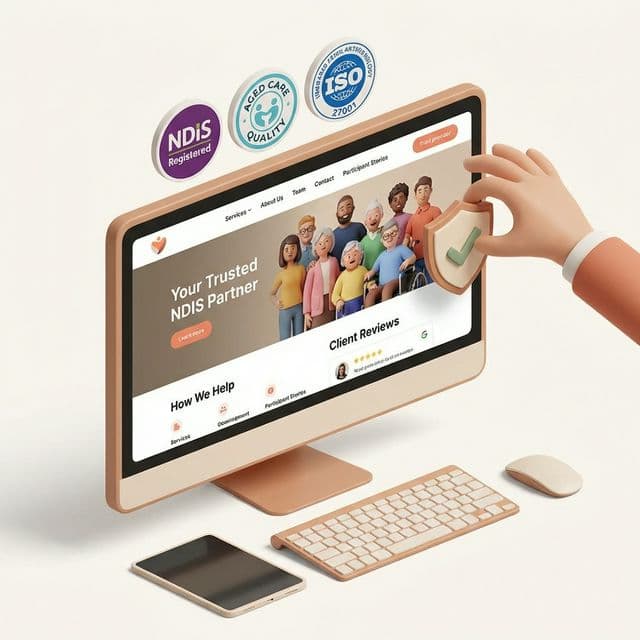
Are you an NDIS Registered Provider? Do you have ISO certifications? These shouldn't be hidden in the footer. Place trust badges high up on your homepage and landing pages. These verifiable icons tell the user immediately that you are a legitimate, audited, and safe choice.
Need a website that truly represents your care? Check out our dedicated NDIS Web Design solutions.
Responsive Support and Real-Time Interaction
Many participants prefer to ask questions before booking a service. Integrating a simple, accessible contact form or a "Click to Call" button that works perfectly on mobile is essential. When a user feels like they can reach you easily, their trust in your service increases exponentially.
Final Thoughts
In 2026, a "good" NDIS website isn't enough—it must be a "trusted" one. By prioritizing accessibility, authenticity, and transparency, you can turn your website into your most effective recruitment and retention tool.